
modular kitchen accessories
Magic Corner Kitchen Basket Organizers
Jul
Maximizing tight corner space is the ultimate challenge in modern apartment layouts across Dhaka and Chittagong. Integrating an engineered Magic Corner slider system transforms unreachable blind spots into fully accessible, high-capacity storage zones. This guide covers modern hardware specifications, installation metrics, and premium material choices tailored for the high-humidity climate of Bangladesh.
Understanding the Blind Corner Dilemma: How Magic Corner Systems Work
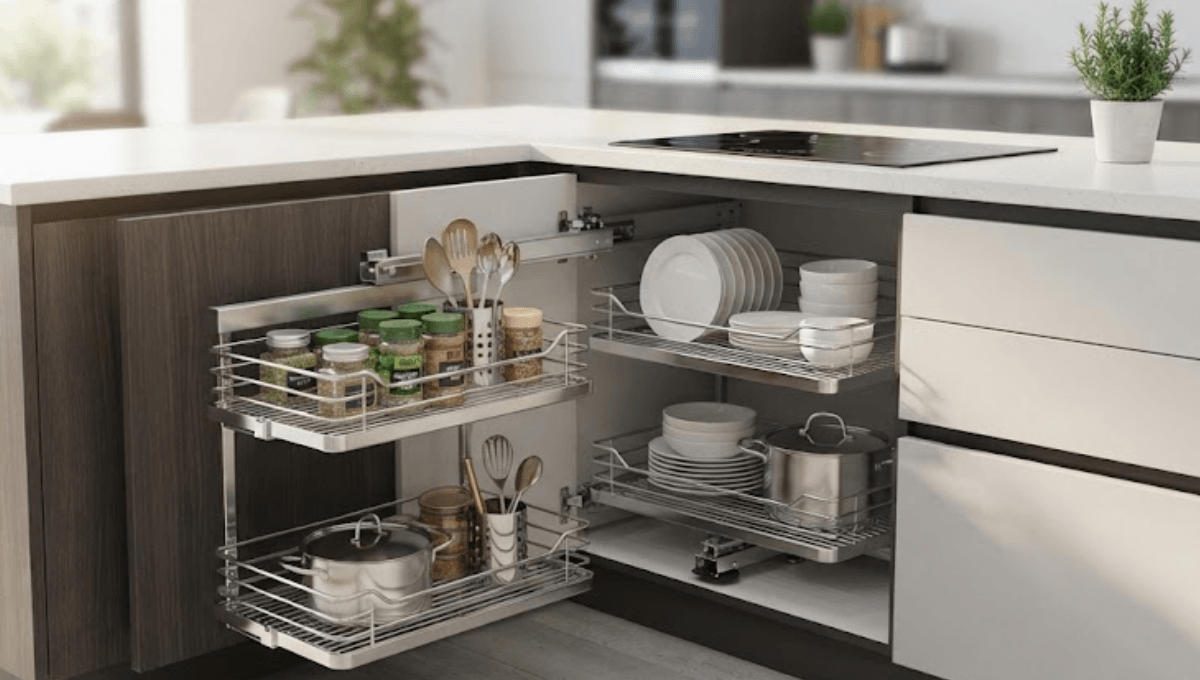
The fundamental challenge in L-shaped and U-shaped modular kitchen layouts is the unreachable blind corner cabinet. Traditional deep cabinetry forms a dark zone where items are frequently misplaced, forgotten, or rendered entirely inaccessible without physical strain. A precision-engineered Magic Corner solves this structural flaw by utilizing a dual-action articulation frame that glides along heavy-duty tracks.
When opening the cabinet, front-mounted baskets pivot outward, pulling rear internal storage into view. This fluid mechanism utilizes heavy-duty slide rails with soft-close dampers to prevent damage. By deploying a synchronized mechanical linkage, it successfully reclaims dead space, ensuring all your pots, pans, and dry goods remain within easy reach.
Depending on your specific floor plan and room layout, these systems are manufactured in explicit directional configurations. You must select either a left-handed or a right-handed model to accommodate adjacent walls, appliances, or room pathways.
Investing in a premium system like a dedicated magic corner right unit guarantees that the structural linkage matches your operational flow perfectly without causing physical collisions with neighboring structural elements.
Strategic Kitchen Space Optimization for Bangladeshi Apartments
In urban hubs like Dhaka, Chittagong, and Sylhet, limited floor plans make kitchen optimization a necessity. With residential kitchens typically ranging from 60 to 120 square feet, every inch is vital. Cluttered countertops reduce your functional workspace, increase stress during daily meal preparation, and naturally harbor unwanted pests if left unorganized.
Transitioning from static carpentry to high-efficiency modular kitchen layouts transforms how your household interacts with the culinary workspace. Implementing specialized storage ideas allows you to compartmentalize items vertically and deeply within structural constraints. By assigning designated zones for cookware, appliances, and spices, you remove visual noise and streamline your cooking workflow.
Furthermore, the tropical environment of Bangladesh presents distinct environmental challenges for household fixtures. High humidity levels and intense daily heat require smart architectural planning to maintain long-term kitchen hygiene. Utilizing fully breathable, open-wire kitchen cabinet organizers ensures consistent air circulation, actively preventing mold development, musty odors, and moisture buildup within dark corner enclosures.
Comparative Breakdown: Corner Systems vs. Traditional Alternatives
When designing a modern layout, selecting the correct hardware mechanism determines the long-term utility of your corner spaces. The comparative matrix below highlights the performance metrics across the top modular systems available today.
Vertical Performance Matrix: Blind Corner Hardware
- Mechanism Type: Magic Corner Articulating Sliders
- Space Utilization Efficiency: 90% to 95%
- Weight Capacity Per Basket: 12kg to 15kg
- Ideal Geometry: Deep rectangular blind corners
- Primary Benefit: Eradicates dead space by bringing internal rear racks entirely outside the cabinet.
- Mechanism Type: 180-Degree Revolving Baskets
- Space Utilization Efficiency: 65% to 70%
- Weight Capacity Per Basket: 8kg to 10kg
- Ideal Geometry: Standard L-shaped corners
- Primary Benefit: Provides semi-circular access using a central rotating pivot rail.
- Mechanism Type: 270 / 360-Degree Lazy Susans
- Space Utilization Efficiency: 70% to 75%
- Weight Capacity Per Basket: 10kg to 12kg
- Ideal Geometry: Square corner enclosures
- Primary Benefit: Offers continuous rotational access for lightweight condiments and small pantry items.
For layouts where a complete slide-out track system cannot be fitted due to specific architectural obstructions, installing a high-quality 180 degree revolving basket offers a durable alternative. While revolving models do not bring items completely forward like an articulating slider, they offer smooth rotation that significantly outperforms standard static wooden shelves.
Comprehensive Guide to Essential Modular Kitchen Accessories BD
Achieving a highly functional, ergonomic kitchen requires balancing your corner storage with a complete ecosystem of coordinated hardware components. Integrating high-performance modular kitchen accessories BD ensures that every workflow zone—from preparation to cleanup—operates at peak efficiency.
High-Capacity Pull-Out Pantry Units
For vertical volume management, high-density pull-out pantry units are exceptional structural investments. These multi-tiered towers optimize tight vertical gaps, allowing you to store bulk ingredients, grains, and oils systematically on deep shelves that slide out gracefully. Implementing a heavy-duty six layer tall unit basket creates an organized, centralized grocery hub that alleviates stress on your main lower base cabinets.
Precision Drawer Organizers and Inserts
Standard deep drawers frequently devolve into unorganized, cluttered spaces where small kitchen utensils become difficult to locate. Upgrading to specialized drawer organizers separates your cooking tools, silverware, and spice jars into clear, designated structural lanes. Utilizing a dedicated, drop-in cutlery basket keeps your preparation tools clean, flat, and instantly accessible during high-heat cooking sessions.
Functional Wall-Mounted System Integration
When lower cabinet volume is entirely maximized, shifting your organizational strategy to the vertical walls preserves open countertop space. Sturdy wall-mounted racks provide excellent, immediate access for daily essentials such as cutting boards, dish towels, and frequently used cooking oils. This configuration ensures your primary prep zone remains completely clear for active meal preparation, significantly upgrading the overall safety and cleanliness of the room.
Material Engineering: Selecting Durable Kitchen Hardware for Bangladesh
The performance and operational lifespan of your modular systems depend heavily on the metallurgy of the chosen frames. Purchasing sub-par components based solely on budget constraints will quickly lead to mechanical failure and structural sagging.
[Material Choice: Premium SS304 Stainless Steel]
│
├─► High Nickel Content (Resists Intense Subtropical Humidity)
├─► Superior Structural Rigidity (Defends Against Heavy Cookware Warping)
└─► Smooth, Non-Porous Chrome Finish (Prevents Sticky Oil & Grease Traps)
Always prioritize high-grade stainless steel kitchen fittings when choosing your hardware upgrades. Premium SS304 alloy features a superior chemical composition with high nickel content, providing ultimate protection against rust in humid climates. Lower-grade options or basic iron frames with thin chrome plating quickly oxidize, peel, and degrade when exposed to kitchen steam, salt, and ambient moisture.
Additionally, pay close attention to the load ratings and engineering specifications of the underlying runner systems. Heavy cast-iron tawas, heavy pressure cookers, and dense stone grinders put immense downward pressure on cabinet frames. Opting for certified durable kitchen hardware built with thick steel profiles and synchronous soft-close tracks ensures the assembly smoothly carries heavy items for years without bending out of alignment.
Precision Cabinet Measurement & Mechanical Installation Guide
Improper cabinet planning is one of the most frequent setbacks during a modern kitchen renovation. Because articulating pull-out systems require exact alignment to operate smoothly, random estimations will lead to serious installation clearance issues.
- Measure Internal Cabinet Depth: Check the clear space from the inner face of the closed door to the rear wall panel, ensuring no protruding plumbing lines or electrical conduits obstruct the path.
- Verify Exact Opening Width: Measure the narrowest point of the clear door opening frame, paying close attention to protruding cabinet hinges that might reduce the usable entry width.
- Confirm Internal Spatial Clearance: Ensure the internal framework is completely square and level, as any minor structural lean will cause uneven friction on the slide rails.
- Test the Full Swing Radius: Map out the external clearance arc to confirm that the outer baskets do not strike adjacent refrigerator doors, handles, or wall structures when fully extended.
Pro Tip: Always cross-reference your internal cabinet dimensions with the manufacturer’s official clearance charts before purchasing hardware. If your wood framework measures even 2mm smaller than the rated minimum specification, the slider assembly will lock up, scrape the inner walls, or fail to latch completely.
Common Procurement Mistakes and Corrective Actions
- Mistake: Choosing Cheap, Corrodible Alloys
- Corrective Action: Demand certified SS304 grade steel and avoid unlabeled, unbranded hardware items.
- Mistake: Ignoring Left or Right Spatial Orientation
- Corrective Action: Double-check your kitchen layout orientation and confirm whether a left-swing or right-swing system is required before ordering.
- Mistake: Overloading Rated Basket Weight Limits
- Corrective Action: Distribute your heaviest cookware across the lower base tracks and reserve the top tiers for lighter pantry items.
- Mistake: Skipping Professional Mechanical Installation Assistance
- Corrective Action: Hire skilled, experienced modular installers to guarantee perfect rail leveling and smooth soft-close operation.
Emerging Design Trends in Modern Bangladeshi Kitchens
The trajectory of residential kitchen architecture in 2026 highlights clean minimalism, ergonomic layouts, and hidden high-efficiency functionality. Homeowners are actively transitioning away from heavy, traditional wooden cabinetry toward sleek, modular profiles with handle-less push-to-open doors. This clean styling relies heavily on internal organizational hardware to keep surfaces completely free of clutter.
Furthermore, the integration of premium soft-close motion control is now standard in contemporary home construction. High-end kitchens feature integrated, moisture-resistant LED strip lights that illuminate deep interior baskets automatically when opened. These modern updates look beautiful while drastically lowering ambient noise, transforming the kitchen into a quiet, integrated extension of the modern living space.
Next Steps & Resource Directories
Browse Full Directories
[Main Hub] > [Modular Kitchen Hardware]
Related Articles
- Magic Corner Right Systems Specification Guide
- Optimizing Corner Cabinets with a 180 Degree Revolving Basket
- Maximizing Vertical Storage with a Six Layer Tall Unit Basket
- Drawer Organization Strategies Using a Premium Cutlery Basket
