
Kitchen Cabinet
Cabinet Lift Mechanism: Smart Storage for Modern Kitchens
Jul
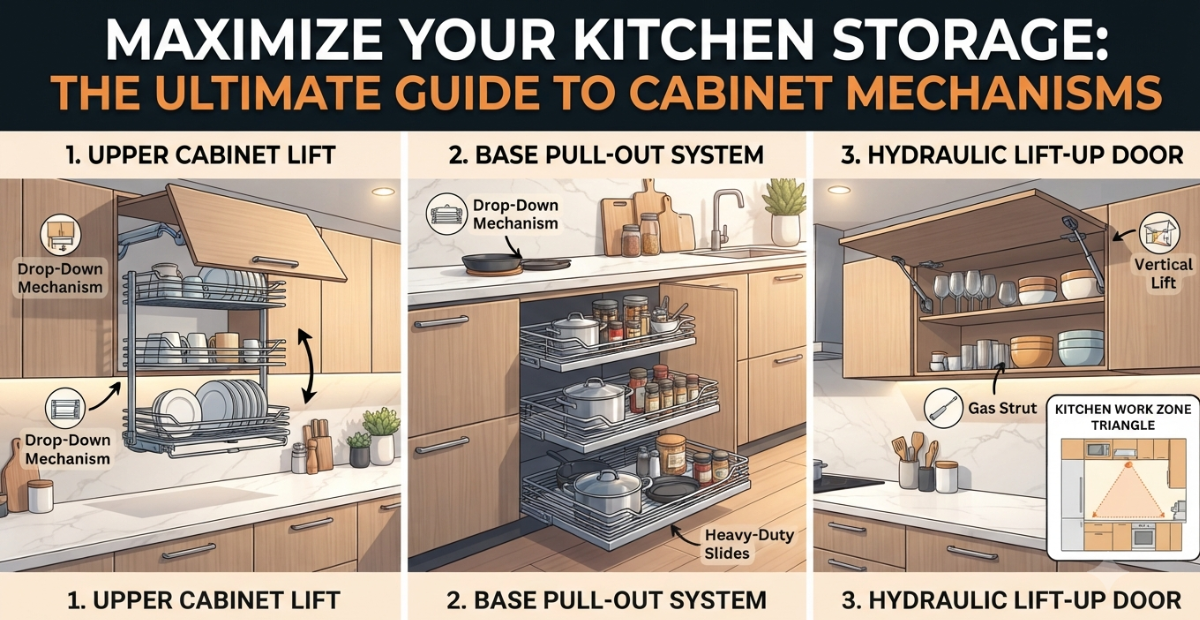
Optimizing overhead storage no longer requires step stools or strained reaching. Integrating a modern cabinet lift mechanism transforms inaccessible upper shelves into ergonomic, high-yield storage zones. This guide analyzes hydraulic lift up systems, base pull-outs, and advanced modular configurations to maximize efficiency in any kitchen layout.
Core Storage Layouts: Lift Mechanisms and Pull-Out Systems
+——————————————————————-+
| MODERN CABINET SYSTEM ENGINE |
+——————————————————————-+
| [Upper Cabinet] --> Elevator Plain Basket --> Eye-Level Access|
| [Overhead Door] --> Hydraulic Lift Up --> Vertical Space |
| [Base Cabinet] --> Multi-Drawer Basket --> Zero Bending |
+——————————————————————-+
Choosing the correct internal hardware requires matching your cabinet architecture with the appropriate mechanical motion. The breakdown below details how specific components solve traditional accessibility constraints.
Cabinet Lift Mechanism
- Best For: Upper cabinets and tall overhead shelving units.
- Key Benefit: Brings high-altitude storage down to eye level smoothly.
- Ideal Kitchen Size: Small to medium layouts where vertical space is premium.
- Mechanical Action: Assisted counterbalanced drop-down motion.
Kitchen Pull Out Systems
- Best For: Base cabinets, deep under-counter spaces, and narrow gaps.
- Key Benefit: Eliminates deep bending and searching through dark corners.
- Ideal Kitchen Size: Any size, particularly highly deep linear kitchens.
- Mechanical Action: Full-extension ball-bearing slides with soft-close dampening.
Hydraulic Lift Up System
- Best For: Overhead doors, microwave garages, and appliance bays.
- Key Benefit: Smooth, space-saving vertical opening that stays out of the way.
- Ideal Kitchen Size: Small and narrow kitchens with limited clearance paths.
- Mechanical Action: Gas-strut or spring-assisted fluid lift arms.
Cutlery Organizer
- Best For: Shallow drawers directly beneath primary countertops.
- Key Benefit: Prevents clutter, stabilizes small tools, and protects sharp edges.
- Ideal Kitchen Size: Any size, vital for high-volume preparation zones.
- Mechanical Action: Static drop-in trays or customizable modular dividers.
Technical Analysis of Upper Cabinet Drop-Down Systems
Upper cabinets often become dead zones for shorter users or items used less frequently. A premium drop-down lift system utilizes a precision-engineered gas spring mechanism to counterbalance the weight of heavy dinnerware. When you pull the handle, the internal chassis extends forward and down, stopping at a comfortable working height.
Modern iterations feature adjustable tension settings. Installers calibrate the internal springs based on the payload weight. If you stock heavy ceramic plates, tightening the tension prevents the mechanism from dropping too fast. For lightweight items like food storage containers, lighter tension ensures effortless operation.
The physical construction relies on heavy-gauge steel or chrome-plated wire baskets. These materials prevent warping under continuous loads. High-sided configurations keep items secure during transit, ensuring glasses and bowls do not slide off the platform when pulled down.
Optimizing Base Cabinets with Smart Kitchen Pull Out Systems
Base cabinets offer deep storage potential but frequently suffer from poor visibility. Items pushed to the rear are often forgotten until they expire. Incorporating heavy-duty pull-out systems replaces static shelving with dynamic drawers that bring the entire contents out into the light.
Low-profile drawer slides mounted to the cabinet floor or side walls form the foundation of these systems. Industrial-grade ball bearings ensure smooth travel even when loaded to maximum capacity. Premium configurations support up to 30 kilograms without sagging or losing alignment.
Standard Base Cabinet: [Front Items] -> [Dark/Inaccessible Rear Space]
Pull-Out Upgraded: [Rear Items] <-> [Front Items] ===> (Full View Outside Cabinet)
Integrating specialized hardware like a thali plate basket organizes cookware vertically. Instead of stacking frying pans and lids precariously, individual slots keep items upright. This layout eliminates the scraping sound of metal on metal and speeds up meal preparation.
Hydraulic Lift Up Systems for Overhead Doors
Traditional swinging cabinet doors pose a hazard in narrow, galley-style kitchens. An open door blocks walkways and creates head-injury risks. A hydraulic lift up system solves this problem by moving the cabinet door vertically, swinging it up and completely out of the traffic lane.
These systems utilize pressurized gas struts to deliver consistent force throughout the door’s travel arc. The initial lift requires minimal effort, after which the pneumatic cylinder takes over, lifting the door smoothly to its peak position. Most systems include a multi-position stop feature, allowing the user to leave the door open at any angle.
Soft-close dampening integrated into the hinge mechanism prevents violent slamming. As the door closes, the hydraulic resistance increases gradually, pulling the door silently against the cabinet frame. This feature extends the lifespan of the cabinetry by reducing structural vibration.
Ergonomic Layouts: Matching Accessories to Kitchen Zones
An efficient kitchen relies on zone planning, ensuring tools sit exactly where their corresponding tasks occur. Smart organization groups accessories into distinct operational hubs.
+——————————————————————-+
| KITCHEN WORK ZONE TRIANGLE |
+——————————————————————-+
| [Prep Zone] --> Cutlery Organizers & Spice Racks |
| [Cooking Zone] --> Stove Drawers & Pot Holders |
| [Cleaning Zone]--> Sink Systems & Waste Management |
+——————————————————————-+
The Preparation Zone
Position your primary workspace between the sink and the refrigerator. This area requires fast access to knives, cutting boards, and seasonings. Installing a dedicated cutlery basket within the top drawer keeps prep tools separated and orderly. Directly below, a deep pull-out drawer can hold larger mixing bowls and food processors.
The Cooking Zone
Centered around the range or cooktop, this zone handles extreme heat and heavy cookware. Standard cabinetry below a cooktop forces cooks to bend down while managing active pans. Replacing these spaces with a specialized stove drawer-basket ensures pots, pans, and lids sit directly beneath the burners for fast access.
The Cleaning and Waste Zone
The area surrounding the sink deals with moisture, sanitation, and waste management. Keep countertops clear by mounting dish drying solutions inside upper cabinets directly over the sink basin. Below the counter, implement smooth pull-out waste containers that slide out when the door opens, keeping trash hidden and odor-contained.
Future Trends: The Evolution of Smart Storage
The kitchen environment is evolving rapidly, driven by automation and advanced materials. Mechanical hardware is shifting from purely manual operation to power-assisted and touchless systems.
- Motorized Lift Mechanisms: High-end kitchens feature electric drop-down shelves activated by voice commands or subtle touch sensors hidden beneath the cabinet trim.
- Integrated LED Lighting: Modern slide tracks and lift arms include low-voltage conductor rails that power internal LED strip lights automatically when a drawer or cabinet opens.
- Soft-Close Sensor Integration: Micro-switches monitor the closing speed of heavy pull-out pantries, applying electromagnetic braking if a drawer closes with excessive force.
- Sustainable Material Compositions: Manufacturers are moving away from basic plastics toward powder-coated alloys, structural bamboo, and anti-microbial stainless steel inserts.
Common Installation Mistakes and Fixes
Implementing advanced hardware requires high precision. Minor alignment errors can cause binding, accelerated wear, and premature mechanical failure.
Inaccurate Weight Calibration
- The Mistake: Loading a drop-down shelf or hydraulic lift door beyond its rated capacity, causing the door to sag or fail to stay open.
- The Fix: Calculate the dry weight of your stored items. Adjust the tension screw on the lift mechanism housing until the unit balances perfectly mid-travel.
Out-of-Square Cabinet Frameworks
- The Mistake: Mounting heavy-duty slide runners inside a cabinet frame that is skewed or unlevel, leading to rough movement and scraping.
- The Fix: Use a digital level and shims during the carcass installation. Ensure the left and right tracks sit perfectly parallel across three measurement points: front, middle, and back.
Obstruction of Clearance Paths
- The Mistake: Installing deep pull-out baskets without verifying clearance for adjacent appliances, door handles, or light fixtures.
- The Fix: Create a full-scale clearance template using painter’s tape on the floor before anchoring the tracks. Verify that doors can clear protruding oven handles or refrigerator panels easily.
Comparative Analysis: Wire Baskets vs. Solid-Base Pull-Outs
The choice between open wire mesh and solid-bottom drawer inserts impacts both daily maintenance and system longevity.
Airflow and Ventilation
- Wire Mesh Baskets: Excellent air circulation. Prevents moisture buildup, making them ideal for fresh produce or freshly washed dishes.
- Solid-Base Pull-Outs: Restricted airflow. Can trap moisture if items are damp, but prevents dust from drifting to lower levels.
Item Stability and Containment
- Wire Mesh Baskets: Small items, spice bottles, or thin utensils can slip through the gaps or tip over easily.
- Solid-Base Pull-Outs: Provides a perfectly flat surface. Keeps small containers stable and catches accidental spills completely.
Cleaning and Maintenance
- Wire Mesh Baskets: Challenging to clean if grease or dust collects on individual wire strands. Requires wiping down multiple surfaces.
- Solid-Base Pull-Outs: Simple to clean. Removable anti-slip mats can be pulled out, wiped down quickly, and dropped back into place.
Weight Capacity
- Wire Mesh Baskets: Medium to high capacity, depending on the wire gauge and structural welds.
- Solid-Base Pull-Outs: Very high capacity. Structural wooden or composite bases resist bending under heavy stacks of ceramic plates.
Pro Tips for Maintenance and Longevity
To ensure your mechanical kitchen accessories operate smoothly for years, implement a regular maintenance schedule.
Pro Tip: Wipe down exposed slide tracks every six months using a dry microfiber cloth to remove dust and cooking grease. Avoid using heavy wet oils or WD-40, which attract grime and gum up internal ball bearings. Instead, apply a thin layer of dry silicone lubricant spray directly to the bearing tracks.
Check the mounting screws on high-use items like an elevator plate basket once a year. The constant mechanical motion and shifting weight can gradually loosen hardware anchored into particleboard or MDF cores. If a screw hole strips out, reinforce the wood using a quality wood filler or structural anchor plug before re-driving the screw.
Next Steps & Resource Directories
Browse Full Directories
Related Articles
- Thali Plate Basket System Optimization
- Cutlery Basket Organization Manual
- Stove Drawer-Basket Space Management
- Elevator Plate Basket Mechanical Installation
